
Waste Reduction
We are working to reduce CO2 emissions and to resolve issues such as the recycling and use of waste materials by reducing waste in our business activities.
We are building partnerships and collaborating with various stakeholders to resolve the environmental issues required of the fashion industry.
Inventory reduction/Waste reduction through purchasing management
During the production process of products, use a large amount of water, energy, and other resources.
In the apparel sector, too, there are issues such as unsold items due to overproduction in anticipation of mass consumption, the generation of inventory, and CO2 emissions due to the incineration of waste.
In order to minimize our impact on climate change, we are taking measures to avoid overproducing products and reducing unsold inventory, considering the impact on the environment.
We will reduce wasteful production through the following activities and measures. We also aim to minimize the final disposal of slow-moving inventory by promoting sales in each channel.

1. Optimization of purchasing
Anticipating demand, we are reforming our MD to improve delivery accuracy and QR accuracy.

2. Improve production planning accuracy
We are able to respond to flexible production plans, such as pre-order orders and made-to-order production through crowdfunding.

3. Improved digestibility
Improve product digestibility through quick response and flexible additional production.
4. Reduction of samples
Use 3D cad to reduce the number of samples to be made.
Recycling of products
Our company effectively utilizes all unsold finished goods that have become difficult to sell as resources and energy by converting them into RPF or BWF.
Specifically, apparel products are converted into RPF, and thermal recovery is implemented to use them as alternative fuel.Metal products, chemical products, and other items that are difficult to convert into RPF are converted into BWF and used as alternative fuel and raw materials at cement plants.
Through these initiatives, none of our finished goods are disposed of in landfills or through simple incineration.
|
Products |
Processing method |
Usage |
|---|---|---|
|
Apparel products |
RPF (Refuse derived Paper and plastics densufied Fuel) A high-quality solid fuel made primarily from waste paper and waste plastics that are difficult to recycle through material recycling, mainly from industrial waste |
Utilized as alternative fuel, implementing thermal recovery |
|
Metal products, Chemical products & Others (buttons, accessories, shoe care products, perfume, etc.) |
BWF化 (Biomass Waste Fuel) A coal substitute fuel regenerated through a proprietary patented processing system that completely recycles oily waste that was considered difficult to recycle and was simply incinerated |
Utilized as alternative fuel and raw materials at cement plants |
Recycling of textile offcuts
We have started an initiative with our main supplier, the textile trading company TAKISADA-NAGOYA Co., Ltd. to recycle textile offcuts generated at our own factories, Sanyo Sewing Co., Ltd.
In this project, we will recycle textile offcuts from wool materials.
The textile offcuts are transformed into recycled RE:NEWOOL®, where all processes from reclaiming wool to spinning, are conducted in Japan through TAKISADA-NAGOYA Co., Ltd.. We will then procure RE:NEWOOL® as a raw material.
Through this initiative, we will promote recycling from fiber to fiber and contribute to reducing the environmental impact by reducing waste at our own factories.
Minimization and recycling of office building waste
We are promoting waste separation activities aimed at minimizing waste generated in our office buildings and promoting recycling.
As a result, in fiscal 2025, the amount of paper combustible waste at the head office building decreased by 20.7% compared to the previous year, significantly exceeding the fiscal 2025 target of a 5% reduction.
Paperless operations
- Implementing a workflow system for internal applications
- Digitizing in-house paper media, etc
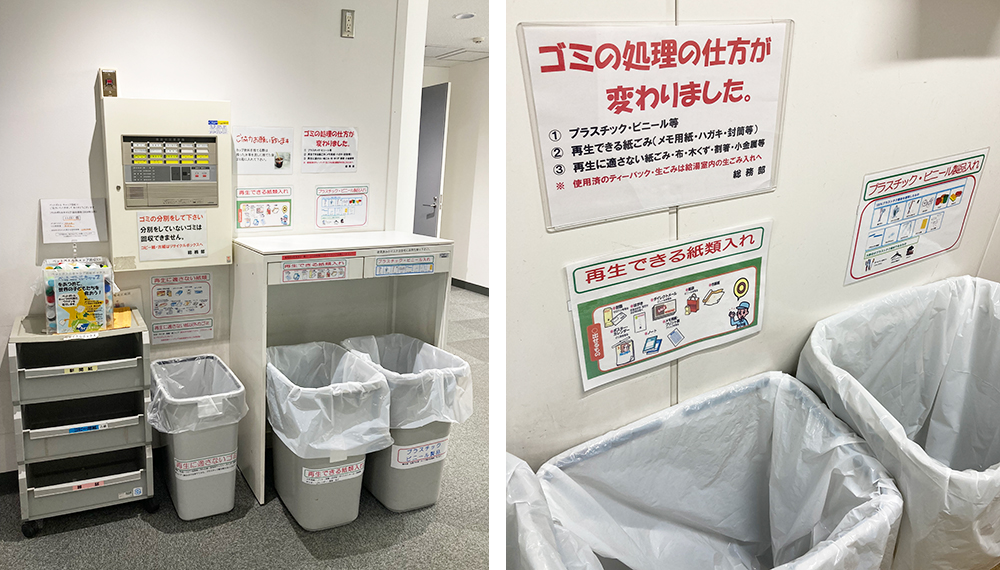
Thorough waste separation
- Installation of trash boxes that make waste separation easy
- In-house awareness of waste separation rules
Internal enlightenment activities
We conduct in-house training to waste reduction.
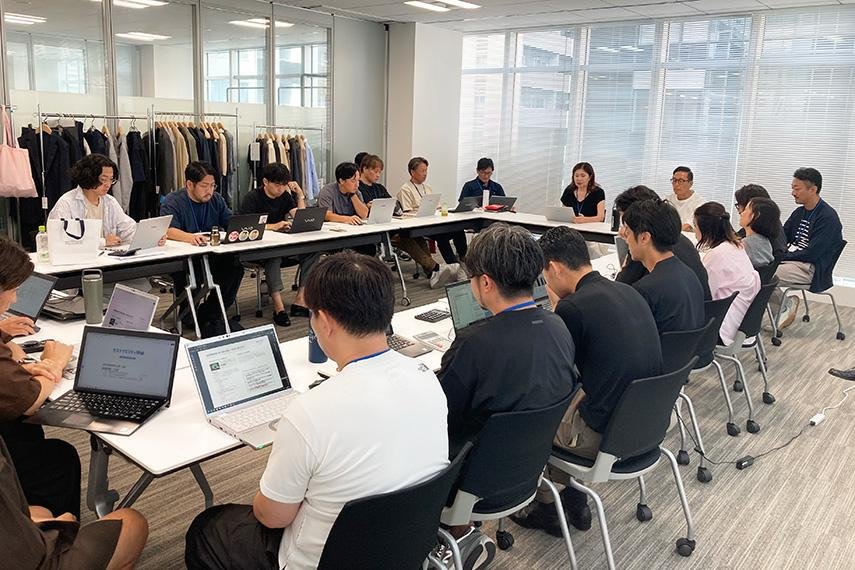
In-house training held in August 2025
Contents of the training
- Reasons for waste reduction
- Waste reduction at the planning and production stages
- Waste reduction at our own factories, etc.